The Crash game is one of the most talked-about formats in modern online casual gaming. Its appeal comes from how simple it looks: a single multiplier rises on the screen, and at some unknown moment the round ends, or "crashes." This guide explains how that works, what the numbers mean, and whether the outcome can be predicted, focusing purely on the mechanics.
The goal here is education. The Crash game is a form of entertainment built around randomness and timing. It is not a method for generating income, and understanding that clearly is part of playing any chance-based game sensibly.
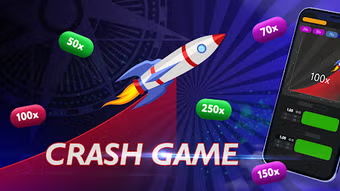
A Crash game is a multiplier-based round game. When a round begins, a number starts at 1.00x and climbs steadily upward. The longer the round continues, the higher the multiplier grows. At a moment that nobody can see in advance, the round stops and the curve "crashes." That single rising-and-stopping motion is the entire concept.
Because the mechanic is so minimal, the Crash game is easy to follow visually. There are no complicated card combinations or long rule books; the only two things that matter are how high the multiplier climbs and the exact instant the round ends. You can see the rising curve in action on the Crash game page.
Every round of a Crash game follows the same simple sequence. Knowing this flow makes the rest of the game easy to understand.
Rounds are short, often lasting only a few seconds, which is why the game feels fast-paced. The display shows the multiplier growing along a curve, and a history strip usually lists where recent rounds crashed so you can see how varied the outcomes are.
The rising multiplier is the heart of the Crash game; it represents how far the current round has progressed. Early on it increases slowly, and as the round continues it can accelerate. The key point is that the multiplier has no fixed ceiling and no fixed pattern. One round might end near 1.10x, while another climbs much higher before stopping.
People sometimes assume the multiplier follows a rhythm, but it does not. Each round is generated independently, so a long climb tells you nothing about the next round, and a series of early crashes does not make a high climb "due." The multiplier simply rises until the round's predetermined crash point is reached.
The cash-out concept is the decision layer of the game. While the multiplier is rising, a player can choose to "cash out," which locks in the multiplier value shown at that exact instant. If you cash out before the round crashes, your choice registers at the displayed multiplier. If the round crashes first, the opportunity to cash out for that round is gone.
This creates the central tension of the format: the longer you wait, the higher the multiplier can climb, but waiting also increases the chance that the round crashes first. There is no "correct" moment to cash out because the crash point is unknown. It is purely a timing decision made under uncertainty.
The crash point in a properly designed Crash game is determined by a random number system. Each round's stopping value is generated independently and is not influenced by previous rounds or by any visible cue on the screen. Many platforms use a "provably fair" approach, where the round's outcome is fixed before the round plays out and can be checked afterward, showing nothing was altered mid-round.
Because the outcome is random, no trick, pattern, or system can predict where a round will crash. Charts of past crashes, "hot" or "cold" streak theories, and timing formulas do not work, because each round is an independent event. Anyone claiming a guaranteed prediction method is simply mistaken about how randomness works.
The honest answer is that the Crash game is dominated by luck, with only a thin layer of decision-making on top. You cannot control or foresee the crash point, so the core outcome of every round is chance. The only element a player influences is the timing of the cash-out, and even that is a guess made without knowing the result.
So while choosing a cautious or bolder cash-out moment is a "decision," it is not skill in the sense of a puzzle where better play reliably produces better outcomes. Randomness has the final say every single round, so it is best treated as light entertainment rather than a contest you can master.
Different Crash game versions include a few common features that shape the experience:
You can explore these features and other titles through the games library.
If you are new to the format, these tips are about understanding and pacing yourself, not about chasing outcomes:
The Crash game is intended for entertainment only and is suitable for adults aged 18+. It is a chance-based game, not a way to make money or a source of income. Because the crash point is random, outcomes cannot be controlled or predicted, and no strategy changes that fact.
Play within clear limits that you set before you start, both for time and for participation. Never chase losses by trying to "win it back," since this mindset ignores the random nature of the game and tends to make experiences worse. If playing ever feels stressful or compulsive, take a break. For more guidance on healthy play habits, see our responsible gaming page, and review how we produce our content on the editorial policy page.
It is a round-based game where a multiplier starts at 1.00x and rises until the round randomly stops, or "crashes." The whole game is built around that single rising-and-stopping motion.
No. The crash point is generated by a random system and is independent of past rounds, so no chart, pattern, or formula can predict where a round will end.
Cashing out is the choice to lock in the multiplier shown at that exact instant before the round crashes. If the round crashes first, the cash-out chance for that round is gone.
It is dominated by luck. The only thing a player decides is the timing of a cash-out, but the crash point itself is random and cannot be controlled or foreseen.
No. Each round is an independent event, so a streak of early crashes or high climbs gives you no information about what the following round will do.
It describes a system where a round's outcome is fixed before the round plays out and can be verified afterward, showing that the result was not altered during the round.
No. It is a chance-based form of entertainment, not an income method. Because outcomes are random, it should never be treated as a financial activity.
Rounds are usually very short, often only a few seconds, followed by a brief pause before the next round begins again from 1.00x.
The Crash game is appealing because of its simplicity: a multiplier rises, a player may choose to cash out, and the round ends at a random, unknowable point. Once you accept that the crash point is genuinely random and that no pattern can predict it, the game is easy to interpret for what it is, a quick, chance-driven piece of entertainment. Keeping that perspective and visiting our blog for more clear explanations will help you enjoy the format responsibly.
Reviewed by: Teen Pati Craze Editorial Team · Last Reviewed: June 2026 · Published: 2026-02-20
New to real-money play? Read our Responsible Gaming guidance first.